
Let me start with a confession: I spec’d ¾” EMT to every single room in my 2,400 sq ft new build. Not just to the media wall. Not just to the attic. I mean everywhere – kitchen island, powder room, front porch ceiling, walk-in closet, even the laundry room. My electrician looked at the plan, blinked twice, and asked if I was building a data centre or a house.
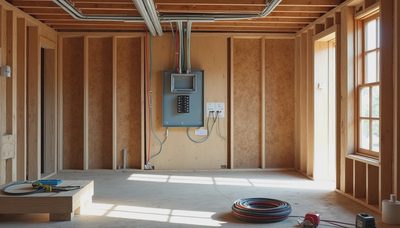
At the time, I had a stack of forum posts and YouTube videos burned into my brain. “Run conduit now or cut drywall later.” “Empty pipe is cheap insurance.” “You don’t know what cable you’ll need in five years.” So I nodded, wrote the cheque, and watched them snake orange EMT through stud bays like they were plumbing a bank vault.
That was eight months ago. The drywall is up, the paint is done, and I’m finally plugging things in. And now, standing in my finished living room, I’m asking myself a question that keeps me up at night: did I just waste $4,000 on glorified pipe that I’ll never use?
I’m posting this not to brag or to complain – I genuinely want to know if I’m the sucker or the savant. And I’m hoping the veterans here can settle this once and for all: is full-conduit over-engineering, or is it the only way to truly future-proof?
Why I went all-in (my original logic)

Let me walk you through my reasoning at the time, because it wasn’t random.
Cable evolution is unpredictable. When I bought my last house in 2015, Cat5e was fine. By 2020, I was pulling Cat6 for 4K streaming and wishing I had fibre to the office. I didn’t want to be the guy fishing HDMI through insulated exterior walls again.
I’m a tinkerer. I change my mind. One year I want PoE cameras; the next I want a wired security keypad; the year after that I’m adding a second access point in the garage. Conduit means I can swap, add, or upgrade without calling a drywaller.
Resale value. I figured a house with “future-ready” infrastructure would stand out. Even if the next owner doesn’t know what EMT is, the realtor can say “this house has conduit to every room” and that’s a checkbox.
My electrician charged per run, not per foot. I negotiated a flat rate for “conduit to all first-floor rooms” – so adding extra drops didn’t cost me incrementally much more. It felt like a no-brainer.
So I drew a map: 15 drops, each with a pull string, each ending in a 4-square box with a blank plate. I even ran a 1” conduit from the basement to the attic, just in case I ever want to add rooftop solar or a Starlink dish.
The doubts that crept in during construction
The first red flag came when the electrician started stapling the conduit to the studs. He kept muttering about box fill, bend radius, and how ¾” EMT was “overkill for a light switch”. He asked me: “What exactly are you planning to pull through this? Three Cat6 cables and an HDMI? You could run that in a Smurf tube and save half the labour.”
I ignored him. But then the inspector came. He spent an extra 20 minutes checking that all my conduit supports were within 3 feet, that the couplings were tight, and that I hadn’t exceeded the 360-degree bend limit between pull points. He passed me, but he said: “First time I’ve seen this much conduit in a residential build that wasn’t a high-end home theatre.”
Then the drywall crew arrived. They had to cut around every single conduit stub-out, which meant more time, more mud, and a few choice words about “the homeowner who thinks he’s an engineer.”
By the time the house was finished, I’d spent close to $4,200 more than a standard rough-in would have cost. That’s money I could have put into better windows, or nicer countertops, or a heat pump.
The real test: six months of living with it
Now I’ve moved in. I’ve got my network switch in the basement, a dozen Cat6 terminations, and exactly zero cables pulled through any of those empty conduits beyond the original drops.
Why? Because I already ran everything I needed during rough-in. I put Cat6 everywhere I could possibly want it. I pre-wired for speakers, sensors, and a doorbell. I’ve got more ports than devices. I’ve used exactly one of the spare conduits – to add a fibre line from the ONT to the router – and that was only because the ISP insisted on their own modem placement.
So now I’m staring at 14 empty pipes, each with a pull string, each carefully labeled, and I’m thinking: this is a monument to my own paranoia.
But here’s where I need your help. I might be wrong. Maybe in year three, I’ll want a dedicated circuit for a wall-mounted tablet that needs PoE and a data line. Maybe in year five, the next-gen HDMI standard will require a different cable, and I’ll be glad I can pull it through without cutting a single hole. Maybe the next owner will be a network engineer who falls in love with my wiring closet.
The opposing view – why strategic runs might be smarter
Let me play devil’s advocate for a moment, because I’ve read arguments from pros who say full-conduit is a trap:
Cost per drop is high – For the price of EMT plus labour, you could buy a premium mesh Wi-Fi system and still have money left over for an electrician to add a single dedicated circuit later, if needed.
Most homeowners never pull new wire – Statistics? I don’t have them, but in every renovation thread I’ve read, the number of people who actually use their spare conduits is maybe 10-20%. The rest just forget they exist.
Conduit fill and bends limit what you can actually pull – ¾” EMT with four 90-degree bends can handle maybe three Cat6 cables and a fibre, but good luck pulling a thick HDMI with a bulky connector. And if the pull string breaks? You’re back to square one.
Technology moves to wireless – Many smart home devices are shifting to Thread, Zigbee, or Matter over Wi-Fi. The need for hardwired data in every corner is declining, not increasing.
Resale value is subjective – Most buyers care about kitchens and bathrooms, not conduit maps. You might scare off a traditional buyer who thinks “too much tech = too much maintenance.”
These are valid points. And I’m starting to think I could have achieved 90% of the benefit with just 4 strategic runs: one to the media wall, one to the office desk, one to the ceiling for a ceiling-mounted AP, and one from the basement to the attic for future solar. That would have cost maybe $800, and I’d have 90% of the flexibility I actually need.
My real question to you – the people who’ve done this

So here’s where I need the collective wisdom:
If you went full-conduit, did you actually use the empty runs later? Be honest – what did you pull, and how long did it take?
If you went strategic, what did you skip and regret? Was there a run you didn’t do that you later wished you had?
For the pros: what’s your rule of thumb? Do you recommend conduit to every room, or only to “high-change” areas like the AV wall, the kitchen, and the network closet?
And the killer question: is “future-proofing” itself a myth? Because no matter how much conduit you run, you can’t predict the cable that doesn’t exist yet. Maybe the real answer is to build a house that’s easy to modify (accessible attic, unfinished basement, low-voltage chase) rather than fully pre-wired.
I’ll close with this: I don’t regret the education. I learned a ton about bend radius, pull boxes, and why electricians hate drywallers. But I’m not sure I’d do it again on my next house. I’d probably take that $4,200 and spend it on a whole-house generator instead – something I actually use every time the power goes out.
But I’m still open to being convinced otherwise. If you’ve got a story about a conduit run that saved your bacon, please share it. I need to justify my decision to my wife, and your success stories might be my only hope.
No letters yet — pray write the first.