I'm about to say something that might get me banned from this forum. Or at least downvoted into oblivion.
Ready?
Neutral-everywhere is overrated.
There. I said it. I know this goes against the gospel of this community. I know every thread here preaches "neutral at every switch box" as the first commandment of smart home wiring. And I know that for most DIYers, that's absolutely the right advice.
But for those of you who are planning your switches thoughtfully – not just blindly spec'ing 14/3 everywhere – I'd argue that neutral-everywhere is a blunt instrument that often creates more complexity than it solves.
Let me explain.
The standard argument (and why it's right for most people)
First, let me give credit where it's due: if you're a first-time renovator, or if you're not going to spend weeks designing your switch plan, or if you're just not sure what you'll eventually install – then yes, run neutrals everywhere. It's the safest, most flexible, and most future-proof approach. It's the "belt and suspenders" solution.
But if you're a planner – if you're the type of person who knows exactly which switch controls which load, who's willing to centralise your smarts, and who doesn't mind a bit of complexity – then you can actually achieve a better, more reliable, and more cost-effective system without a neutral at every box.
Here's how.
The alternative: centralised smart relays

Here's a scenario: you have a room with four loads – the main light, a ceiling fan, under-cabinet LEDs, and a cove light. In the standard neutral-everywhere approach, you'd run 14/3 to each switch location, and install a smart dimmer at each switch. That's four smart switches, each with a neutral, each taking up space in the box.
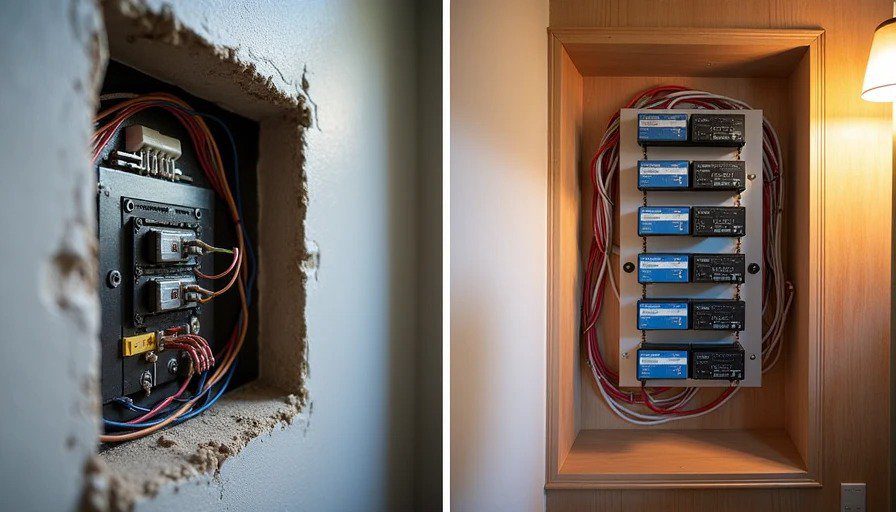
Now, consider a different approach: run all four loads back to a central relay panel in your basement or utility room. Install a single smart relay (like a Shelly Pro 4 or a Fibaro relay) in that panel. Then run low-voltage wires from the relay panel to standard (dumb) switches in each room.
The switches themselves are just momentary buttons – they don't need a neutral, because they're not carrying load current. They're just sending a signal to the relay. The neutral is only needed at the relay panel, which is easily accessible and has plenty of space.
Benefits:
One neutral location instead of 20. You don't need to run a neutral to every switch box – just to the relay panel.
Much cheaper – you're buying one relay for multiple loads, not one per switch.
Easier to retrofit – you can replace a standard switch with a momentary switch without needing a neutral.
More configurable – you can program the relay to handle scene control, dimming, and schedules.
Trade-offs:
You need to plan where the relay panel goes.
You need to run low-voltage wires from each switch to the relay panel (which adds complexity).
It's not as forgiving if you change your mind about which switch controls which load.
The "smart socket" alternative
Another approach: instead of putting smarts in the switch, put them in the load itself. For lamps and table lights, you can use smart bulbs or smart plugs – they don't need a neutral at the switch because the smarts are at the socket.
For ceiling lights, you can use smart fixtures that have integrated dimming and Zigbee/Z-Wave. Again, the switch is just a dumb switch that toggles power – no neutral required.
Benefits:
Simpler wiring.
Works with existing setups.
Easy to upgrade (just change the bulb).
Trade-offs:
Smart bulbs are expensive, and if someone turns off the dumb switch, the smart bulb loses power.
Not great for loads that don't support smart bulbs (like low-voltage LED strips).
The "keep it simple" alternative: use existing travelers for 3-ways
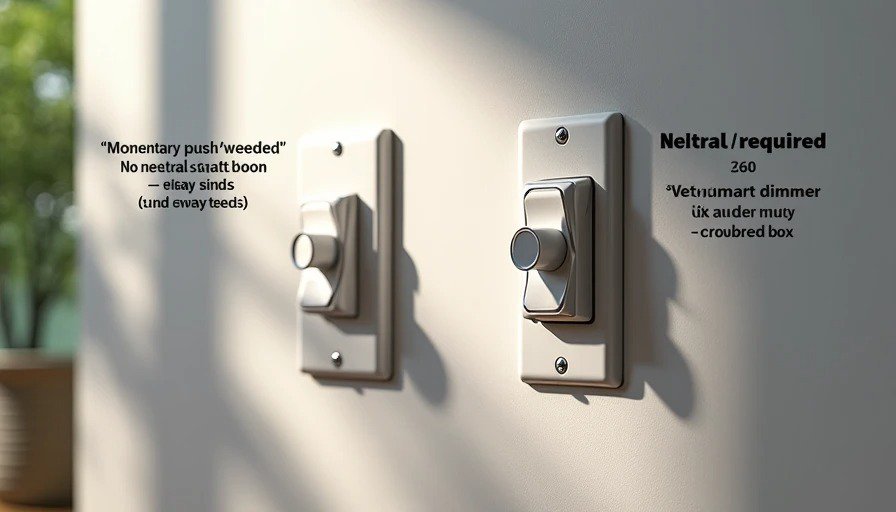
One of the biggest objections to neutral-everywhere is: "but I already have 14/2 to all my switches, and I don't want to repull everything." In some jurisdictions, you can use the traveler wire in a 3-way as a neutral – but that's not always allowed.
Here's a workaround: instead of running a neutral to the secondary switch in a 3-way, use a wireless switch that communicates with the primary switch. Lutron Pico, Inovelli wireless remotes, and Shelly's wireless switches can all be mounted without a neutral – they run on batteries.
Benefits:
No neutral needed at the secondary location.
Clean installation.
Trade-offs:
Battery replacement.
Slight latency (though usually unnoticeable).
The real reason neutral-everywhere is overrated
Here's the thing: a neutral is only useful if you actually need it. And most smart switches don't need a neutral to function – they need a neutral to power themselves (the radio, the microcontroller, the LED). But if you're not putting a smart switch in that box, you don't need a neutral.
The neutral-everywhere mantra assumes that:
You'll be using smart switches in every location.
Those smart switches will be in the switch box, not centralised.
You're willing to pay for the extra wire and labor.
If any of those assumptions are false, you're adding cost and complexity without benefit.
What I actually recommend
I'm not saying "don't run neutrals." I'm saying "run them strategically."
Here's my approach:
Run neutrals to high-use areas – living room, kitchen, bedrooms where you'll definitely want smart dimming.
Skip neutrals in low-use areas – closets, garages, utility rooms, and locations where you'll use a centralised relay.
Use centralised relays for multi-load rooms – put the smarts in the panel and the switches in the wall.
Use wireless switches for secondary 3-way locations – save the wiring for when you really need it.
This gives you flexibility, saves money, and reduces box fill.
My own experience
I've wired three houses this way. The first one was neutral-everywhere – and it worked fine. But it was expensive. The second was strategic neutrals + centralised relays – and it was cheaper, more reliable, and easier to maintain.
The third house, my current one, is all centralised relays in the basement. I have 16 dimmer channels and 8 relay channels, all controlled by a single panel. The wall switches are momentary buttons – they don't need neutrals. The only loads that go through the switches are the ones I directly control.
The result? No humming. No flickering. No box fill problems. And when a dimmer fails, it's in the panel, not behind a wall.
The one caveat
This approach doesn't work for everyone. You need to be comfortable with planning, and you need to be willing to run low-voltage wires. It's not a "plug and play" solution – it's a "think and design" solution.
But if you're reading this forum, you're already thinking about this stuff. So maybe it's worth considering.
Now, the rebuttal
I know this will spark debate. And I want to hear it. The whole point of this forum is to share different perspectives. So tell me:
Electricians: is this approach code-compliant in your jurisdiction?
DIYers: have you tried centralised relays?
Integrators: do you prefer neutral-everywhere, or do you use a hybrid approach?
I'm not saying I'm right. I'm saying this is worth thinking about. Because the goal isn't a neutral at every switch. The goal is a smart home that works. And there's more than one way to get there.


No letters yet — pray write the first.